
Microlight Statistics 2026
The British Microlight Aircraft Association (BMAA) recently published its LIAC Review for 2026. The presentation provides an excellent update on licensing statistics and trends within the UK microlight community. Let's look at these numbers to see how student pilots and flight instructors are shaping the future of general aviation.
Trend of NPPL Applications
Looking at the trend of applications from 2010 to 2025, there is a clear downward trajectory.
Total applications have dipped from over 400 in the early 2010s to exactly 200 by the end of 2025.
Ab initio and credit applications track closely alongside this, settling at roughly 170 in 2025.
While these numbers are lower than previous decades, the consistent flow of new students shows a dedicated core of aviation enthusiasts successfully entering the sport.

Flexwing vs Three-Axis Training
The shift towards three-axis aircraft continues to be highly pronounced. When comparing flexwing and three-axis applications between 2010 and 2025, three-axis remains the clear favourite.
By 2025, three-axis training applications hovered around 175.
Flexwing applications for the same year fell to approximately 25.
The data reflects a growing preference for the aeroplane-like feel of three-axis machines, which also dominate the General Skill Test (GST).

The most popular aircraft flown on the GST include the Ikarus C42, Eurostar, and Skyranger.

Student Demographics
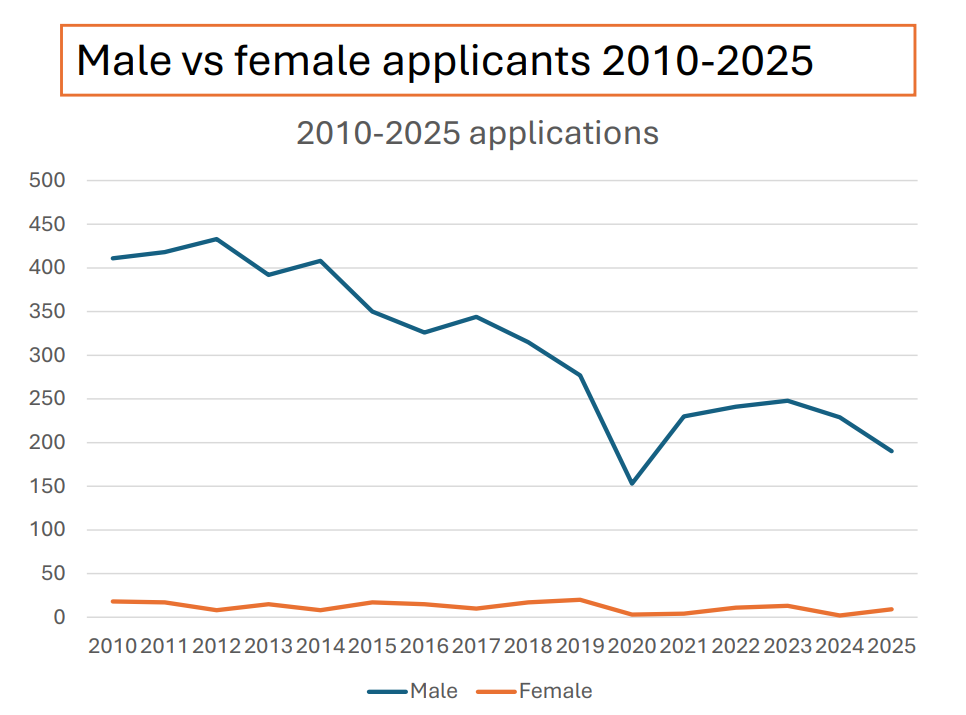
The gender gap remains significant.
Male applicants consistently outnumber female applicants by a massive margin.
For 2025, the number of female applicants was exceptionally low, sitting visually close to 10, compared to nearly 200 male applicants.
Interestingly, while male applications dropped between 2024 and 2025, female applications saw a slight uptick. This means the proportion of female applications as a part of the whole actually increased over the last year.
Fresh Pilot Profile
What does the typical new microlight student look like? The 2026 LIAC review gives us a very clear picture of ab initio students:
The average age at the start of a microlight course is just over 44 years old.
The most common birth year for ab initio pilots is 1966.
The most common birth month for these students is January.
The average course length spans just over two years.
The average total hours required for an ab initio NPPL course is 58 hours and 17 minutes.
The average solo time under training at course completion is 12 hours and 56 minutes.
These figures show that taking your time to learn properly is perfectly normal. Balancing flight training with work and family takes time, and taking over 58 hours to pass your GST is completely standard.
Operational Limitations
A striking piece of data surrounds operational limitations on pilot licences.
Since 2010, there have been 893 applications for an NPPL with operational limitations.
Only 512 applications have been made to remove these limitations.
This means 42.67% of NPPL holders with operational limitations continue to fly without removing them all.

The BMAA reminds students that navigation training to remove these limitations must always be certified in the applicant's logbook. Furthermore, to remove the passenger carriage limitation, pilots must have completed 10 hours as Pilot in Command (PIC) and 25 total flying hours, which must be verified and certified by a Flight Examiner.
Instructor Statistics
The health of our flight schools relies on instructors. The 2025 testing data shows a steady influx of teaching talent.
There were seven new Restricted Flying Instructors (FI[R]s) tested in 2025.
There were 12 new unrestricted Flying Instructors (FIs).
Only two tests were failed in 2025, both by the same candidate.
![Bar chart titled "Number of new FI[R]s and FIs per year" from 2013-2025. Blue bars: New FI[R]. Orange bars: New FI. Varying heights show changes.](https://static.wixstatic.com/media/16f33d_23de609dfc5d416698ffe2d23a0cb6f0~mv2.png/v1/fill/w_980,h_355,al_c,q_85,usm_0.66_1.00_0.01,enc_avif,quality_auto/16f33d_23de609dfc5d416698ffe2d23a0cb6f0~mv2.png)
Interestingly, when looking at the control types for new FI[R]s in 2024 and 2025, 100% were for three-axis aircraft. There were zero new flexwing instructors joining the ranks in those two years.
![Line graph titled "New FI[R] control types" shows 3 Axis and Flexwing trends from 2013-2025. 3 Axis in blue, Flexwing in orange.](https://static.wixstatic.com/media/16f33d_a7f9f474e2e14c29a96adbf26ff46a73~mv2.png/v1/fill/w_703,h_446,al_c,q_85,enc_avif,quality_auto/16f33d_a7f9f474e2e14c29a96adbf26ff46a73~mv2.png)
A Quick Tip on Paperwork
Finally, a quick tip for all student pilots submitting their paperwork to the BMAA. The ratio of applications returned or delayed due to errors or omissions is currently 31.62%. This is up by 1.35%. Taking an extra five minutes to double-check your forms can save you a lot of waiting time!
Microlight Student Pilot? Boost Your Flying Confidence This Spring!
Springtime offers ideal flying conditions to advance your microlight training. Ace your written exams effortlessly with QuizAero’s targeted study resources, created specifically to help microlight students succeed first time. Ready to take your flying to new heights? Join thousands of fellow British pilots already soaring ahead. Sign up for QuizAero Bitesize today and make this spring your season of flight!


Comments